

The Triangular Struggle: Can Your Party’s New CEC Crack the Union Question?
Build independent political education, and resist subordination to any bureaucracy

TL;DR The Many’s 14-7-3 victory in Your Party’s CEC elections, followed by a sweep of all eight officer positions and the appointment of Corbyn as parliamentary leader, confirms the consolidation of a bureaucratic-parliamentary machine. The new CEC has maintained the data monopoly, obstructed dual membership through administrative stalling, disqualified socialist candidates, refused to recognise proto-branches, and remained silent on industrial strategy and the Employment Rights Bill. The party leadership is aligning with the bureaucratic pole of the trade unions: coordination with general secretaries, not mobilisation of the rank and file.
This article argues that Your Party members who are union activists must now build rank-and-file independence from both the party machine and the union bureaucracy. Britain’s unitary union movement is a strategic asset; fragmenting it along party lines would be a historic mistake. But subordinating industrial organising to a CEC that treats the membership as a mailing list would be equally fatal. The models that work: the PTB in Belgium, People Before Profit in Ireland: refuse both errors. Your Party’s socialists should follow their example: be the most effective reps in every workplace, build independent political education, and resist subordination to any bureaucracy, however left its credentials.
Your Party benefits from Britain’s unitary union movement: a strategic asset that the fragmented European left would kill to have. In France, socialists must navigate the CGT, the CFDT, FO, and Solidaires; in Belgium, the socialist FGTB and the Christian-democratic CSC; in Spain, CCOO and UGT, both structurally compromised by decades of subsidised dependence on the PSOE. In Britain, there is one TUC. One movement. One set of structures through which six and a half million workers are organised, however imperfectly, however bureaucratically, however conservatively. The socialist left inside Your Party must not squander this by fragmenting the union movement along party lines. That would be a historic betrayal of the British labour movement’s greatest structural advantage.
But the CEC election results have closed off the route that many hoped would avoid this dilemma altogether. The Grassroots Left did not win. The Many took fourteen of twenty-four seats, swept all eight officer positions, and appointed Corbyn as parliamentary leader in their first meeting on 8 March. The Grassroots Left holds seven seats. Three independents, including Naomi Wimborne-Idrissi in the South East and Niall Christie in Scotland, hold the remainder. The collective leadership model that Liverpool’s founding conference mandated has been replaced, in practice, by a leader-led machine managed by Corbyn’s inner circle and operationalised through Socialist Action’s factional methods (by both SA and others with similar Labourite methods).
The question is no longer whether a friendly CEC will deliver an industrial strategy for the party. It will not. The Many’s silence on workplace organising since their victory is not an omission; it is a signal. Corbyn’s post-election statement spoke vaguely of “building power everywhere: in our workplaces, in our communities and in Parliament.” There has been no policy paper on union orientation, no statement on the Employment Rights Bill, no indication that the new CEC regards the workplace as anything other than a backdrop for parliamentary politics. The question is now sharper, more urgent, and more consequential: how should socialists inside Your Party organise industrially when the party’s own leadership has aligned itself with the bureaucratic pole of the triangle?
Ernest Mandel understood this problem better than anyone on the twentieth-century left. His analysis of trade union officialdom identifies a triangular struggle: three forces in dynamic tension. Capital presses the bureaucracy to discipline militants and deliver predictable outcomes. The rank and file presses it to fight harder and deliver material gains. The bureaucracy pursues institutional preservation, factional advantage, and the maintenance of its mediating role. The same officials who fight genuinely on wages may suppress genuinely on political questions. The same faction that exposes corruption may deploy corruption’s methods when its own power base is threatened.
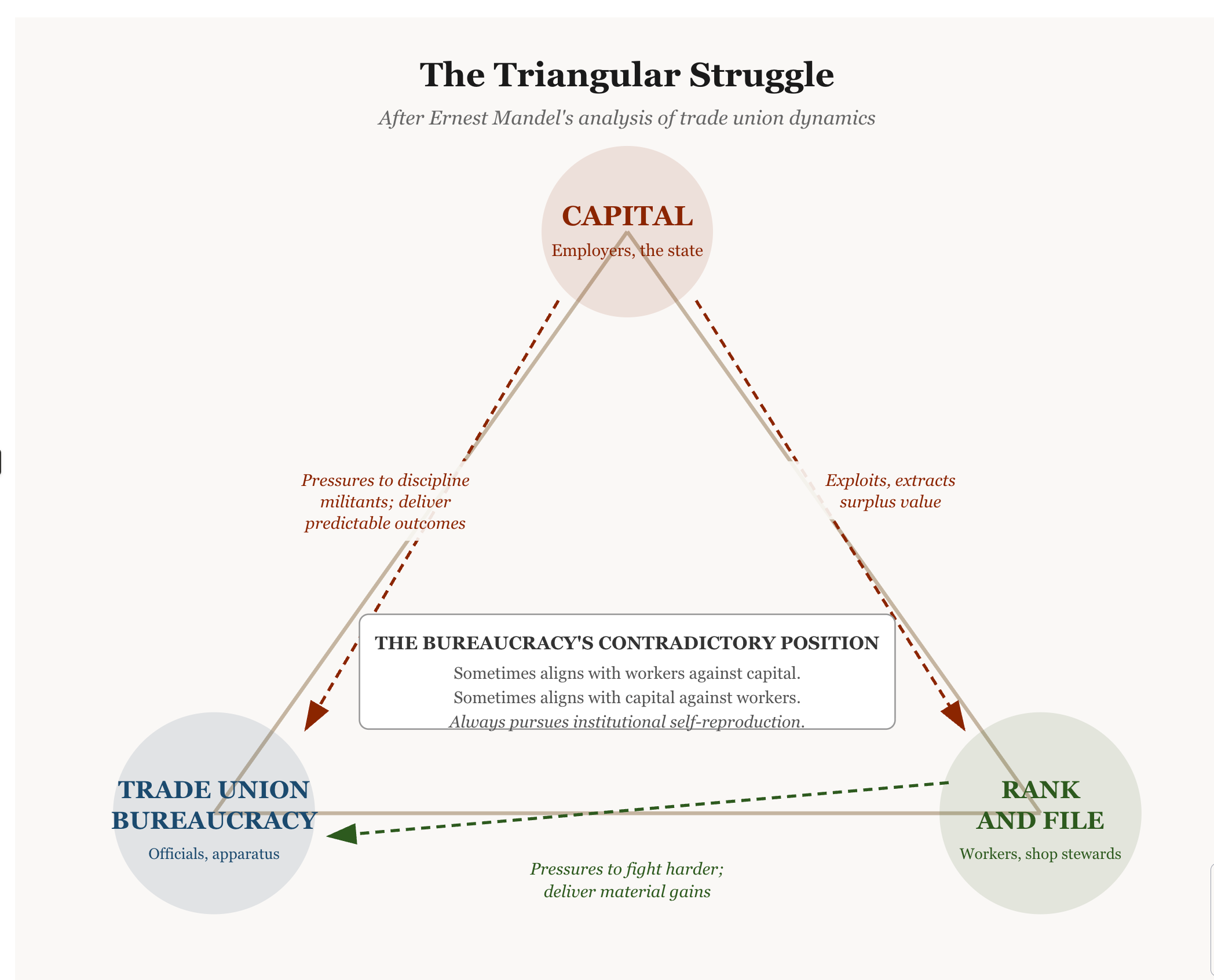
Red Mole demonstrated this in December with the Unite case study. Sharon Graham’s administration genuinely exposed the McCluskey-era financial scandal: £96.5 million on a hotel, £70 million unaccounted for, the contract awarded to McCluskey’s personal associate. Real corruption. Real reform. And the same administration systematically blocked Palestine solidarity motions, threatened a senior officer with gross misconduct and pension loss for speaking at a ceasefire rally, and instructed staff not to support campaigns against arms factories. Same methods. Different targets. Different factional base.
Now apply that framework to Your Party itself. The Many’s CEC is not the rank-and-file pole of the triangle. It is the bureaucratic pole of a nascent party, aligning itself with the bureaucratic pole of the trade unions: general secretaries who share platforms with Corbyn on foreign policy but have no intention of affiliating to a formation they cannot control. The appointment of Louise Regan as Political Officer, an NEU activist and Corbyn ally, signals coordination with the top, not mobilisation from below. For general secretaries like Sharon Graham, Daniel Kebede, and Fran Heathcote, who have distanced themselves from Labour, Your Party under The Many is at its most useful as a parliamentary pressure valve rather than as a vehicle for rank-and-file power that might threaten their own institutional positions.
The Machinery of Exclusion
The Many’s victory would matter less if the party retained the democratic mechanisms to hold the CEC accountable. It does not.
The founding conference voted 69% for dual membership: the right of Your Party members to hold membership in other socialist organisations. The Many has buried this through administrative stalling, drafting CEC election rules that bar dual membership “until the CEC approves specific national parties as aligning with the Party’s values.” No white list has been published. The result is a de facto proscription regime. Dave Nellist, former Labour MP and TUSC chair, was disqualified from the CEC elections for his Socialist Party membership. April Ashley, a Unison NEC member and elected black members’ representative, was disqualified. Muhsin Manir, a Unite branch organiser and bus driver, appealed and was rejected.
Consider what this means for industrial strategy. The organisations with the deepest roots in workplace organising: the Socialist Party in PCS and Unite, the SWP in the NEU and UCU, rs21 across several unions: are precisely the organisations whose members have been (or, in the case of rs21, could be) excluded from Your Party’s leadership structures. The people who know how to file a grievance, build a picket line, and organise a workplace ballot are the people the CEC is purging. This is not incidental. It is the logic of Socialist Action machine politics learned from the labour bureucracy: a small cadre controls the apparatus by excluding any organised current capable of challenging its dominance.
The proto-branches that Your Party members built from the ground up, often with exemplary organising work in their communities, remain unrecognised. The Many’s proposal for “official branches” requires inaugural all-member meetings with 20% turnout thresholds: a deliberate hurdle that ensures the centre controls the pace and character of local organising. The membership data remains locked at headquarters. Without it, no branch can know which of its members are in which unions, which workplaces are organised, where the unorganised workers are. The “living map” that Inacio Vieira described on his Substack before the election remains an instrument of central control, not a tool for democratic organising.
The rs21 withdrawal current has grown since The Many’s victory. The Grassroots Left has organised as a formal opposition, calling for “no more witch-hunts” and “accountable, transparent and democratic structures.” But an opposition that is denied access to membership data, whose candidates are disqualified, and whose branches are not recognised is an opposition that exists on paper but not in the party’s operational reality. TUSC has already appealed to Your Party supporters to help get socialism on the ballot in May, an implicit acknowledgement that Your Party itself may not be the vehicle.
The Trap of the Party Caucus
In this context, the temptation will be to respond with the most familiar tool in the Marxist left’s organisational toolkit: build a party caucus inside the unions. Coordinate Your Party members. Run slates. Capture positions. It worked for the Communist Party of Great Britain for four decades: factory groups in engineering, print, and the docks; Broad Left formations that united Communists and non-Communist left-wingers to win leadership positions in the AUEW and the NUM; genuine workplace power that shaped the 1972 and 1974 miners’ disputes.
It also destroyed itself. The CPGB’s industrial strategy was subordinated first to the party’s political line, then to Moscow’s foreign policy priorities, and finally to the factional interests of the apparatus itself. By the 1980s, the Broad Lefts had become vehicles for a party that could no longer influence the class struggle. The factory groups dissolved. The workplace power evaporated. What remained was a network of ageing officials whose positions depended on factional loyalty rather than democratic mandate: precisely the United Left model that produced the Birmingham Hotel scandal forty years later.
The European evidence confirms the pattern. When Rifondazione Comunista entered the Prodi government in Italy in 2006, its presence inside the CGIL and the radical cobas movement became a liability. The party was forced to support budgets containing precarious employment measures and military spending. Its union base revolted. Within two years, Rifondazione had lost every parliamentary seat. Podemos committed the opposite error: its left-populist strategy deliberately distanced the party from CCOO and UGT, treating the unions as relics. When Podemos entered government with the PSOE, it had no industrial power base capable of disciplining the leadership. The party collapsed from within.
Two paths to the same destination. Rifondazione subordinated its politics to its union positions and lost both. Podemos abandoned union organising for electoral populism and discovered that a party without roots in the working class has no anchor when the storm comes.
Under a Many-controlled CEC, the danger for Your Party is worse than either. A party caucus model would mean organising industrially on behalf of a leadership that has already demonstrated its willingness to purge the very socialists who do the organising. Every union position captured in Your Party’s name would strengthen the CEC’s hand, not the rank and file’s. The McCluskey & Corbyn network’s capture of the party’s founding structures: the keynote at Liverpool, the expulsions, the data monopoly: is the template. Building union power that feeds back into a machine you don’t control is not solidarity. It is subsidy.
The Models That Work
Two contemporary formations have navigated this terrain more successfully than any other.
The Workers’ Party of Belgium, the PTB, encourages its activists to be “very involved and very industrious” within the existing union confederations. PTB members inside the unions do not operate as an overt “PTB caucus.” They operate as the most effective shop stewards, the most reliable organisers, the people who actually do the work. The party maintains workplace cells alongside residential sections: a dual structure that allows industrial work and community organising to reinforce each other. In Wallonia, FGTB metalworkers have openly supported PTB campaigns. In Antwerp, the party has broken the traditional hegemony of the Belgian Socialist Party inside the FGTB. Red Mole analysed the PTB model in December critically, but the industrial strategy is the element that deserves closest attention.
People Before Profit in Ireland offers the other model. PBP members organise within SIPTU, Mandate, and the TUI not through an official party caucus but through independent rank-and-file networks like ASTI Fightback. The PBP Trade Union Department pushes for militant demands: the €15 living wage, statutory sick pay, opposition to the social partnership model. The relationship with union leaderships is frequently adversarial. That is the point. PBP’s members are the most effective reps not because the party tells them to be, but because their politics demand it. And they maintain their own political education through the Socialist Workers Network, RISE and other frameworks: reading groups, the Dublin Radical Bookfair, political schools, an increasingly shared analytical framework that allows coordination without capture.
What unites the PTB and PBP models is what they refuse to do. Neither attempts to fragment the existing union movement along party lines. Neither subordinates its politics to the institutional interests of any union bureaucracy. Both insist on political independence while engaging fully in the daily reality of union organising. Both build their own educational and analytical capacity so that their members can operate as a politically coherent current without needing to capture the structures they work within.
What Your Party’s Socialists Should Do
The Many’s CEC will not deliver an industrial strategy worthy of the name. It will pursue high-level coordination with general secretaries. It will treat unions as sources of institutional legitimacy and, eventually, campaign funding. It will not build workplace power, because workplace power threatens the parliamentary-bureaucratic model it exists to serve.
Your Party’s socialists: the Grassroots Left CEC members, the rs21 activists in the proto-branches, the Anticapitalist Resistance members, the unaffiliated militants who joined because they wanted a party that fights: must build an industrial orientation independently of the CEC. Not against the party. Not outside the party, at least not yet. But without waiting for permission from a leadership that has demonstrated it will not grant it.
Three things follow.
First: be the most effective, most reliable, most politically serious people in your workplaces and your broad lefts. Not the people who turn every union meeting into a recruitment pitch. The people who actually organise. Who file the grievances. Who build the picket lines. Who do the tedious, essential work that earns the trust of colleagues who have never heard of Your Party and don’t care about its CEC elections. The PTB model. Be industrious. Be indispensable. Let the politics follow from the practice.
Second: build independent educational and organising infrastructure. Not a caucus. Not a faction. A programme. Reading groups on Mandel’s analysis of union bureaucracy. Campaign schools on workplace organising. Bulletins that analyse industrial disputes and connect them to broader politics. A shared analytical framework that allows Your Party members inside Unite, the NEU, UCU, PCS, and the smaller unions to understand why they are doing what they are doing, and to coordinate without building a formal factional structure that would poison their relationships with non-party colleagues in the broad lefts.
Third: resist the pull of the union bureaucracy with the same determination you resist the pull of the CEC. Mandel was explicit: party positions should never be adjusted to preserve relationships with union leaders, however left their credentials. The Graham administration’s suppression of Palestine solidarity inside Unite demonstrates that “industrial militancy” credentials provide no guarantee of democratic practice. The Many’s alignment with general secretaries does not make those general secretaries allies of the rank and file. It makes them allies of the machine.
Beyond the Workplace
There is a fourth dimension that the existing unions have failed to develop and that Your Party’s branches, if they are ever allowed to function, could pioneer. Union density stands at 23% overall: 50% in the public sector, a miserable 12% in the private sector, below 5% in hospitality, below 3% in logistics and the gig economy. The Employment Rights Bill mandates that employers notify workers of their right to join a union and provides new rights of workplace access. This creates a legal opening that did not exist twelve months ago.
Your Party’s proto-branches, the ones The Many refuses to recognise, are already embedded in working-class communities. A branch that connects housing campaigns, anti-racist organising, and solidarity work to the practical business of building union power in unorganised workplaces: that is a model the existing unions have only experimented with. Unite Community branches organise the unemployed and carers. The IWGB and UVW have pioneered models for gig economy and migrant workers. The South African COSATU tradition of social movement unionism understood that workers cannot extricate themselves from their communities. The Italian Camere del Lavoro offer community hubs that bridge workplace and neighbourhood.
The CEC will not build this. The CEC is proposing Members’ Policy Commissions: centrally managed structures that replicate Labour’s National Policy Forum, draining power from branches and delegates into rooms where “experts” and “stakeholders” vet policy for electoral acceptability. The community-unionism model requires the opposite: autonomous local structures with the data, the resources, and the political confidence to organise on their own terms. It requires, in other words, exactly what the Grassroots Left fought for and The Many is determined to prevent.
Scotland: Seven Weeks and Counting
One further crisis demands immediate attention. Your Party Scotland’s founding conference voted 63% to become a pro-independence party, alongside 59% for organisational independence as a sister party to rUK Your Party. It elected an SEC granting Scottish members autonomy over strategy and necessitating a parity committee to coordinate with rUK Your Party, for example over candidate selection. The Many-controlled CEC has ignored this demand. The Holyrood elections are on 7 May. That is not next year. That is seven weeks from now.
Scotland’s single CEC representative, Niall Christie, is an independent: not aligned with either slate but who was supported by Grassroots Left. The collapse and deregistration of the Alba Party in March 2026 creates an opening on the Scottish left. Three talented Glasgow councillors have defected with other members from the Scottish Greens to Your Party. But without a parity committee, without autonomous Scottish structures (and financing), without an agreed strategy for contesting a proportional representation election in a four-party system, Your Party Scotland faces Holyrood with an ambiguous constitutional relationship to its own CEC, uncertain access to resources, and no clear platform. As a result, many proto-branches and regions are deciding not to stand: the Corbyn machine is not sharing its resources with proto-branches.
For Scottish trade unionists, a party that cannot resolve its internal national question is not a credible vehicle for defending Scottish workers’ interests. Scottish unions operate in a devolved political environment with its own parliament, its own health service, its own elections. They cannot be directed from London. The CEC’s refusal to establish the parity committee and similar support is not administrative delay. It is the same centralising logic that refuses to release membership data or recognise proto-branches: the machine must control everything, or it controls nothing.
The Clock Is Ticking
The Many has won. The machine is in place. The officer positions are filled, the data is locked, the dual membership mandate is buried, the proto-branches are unrecognised, the Policy Commissions are being assembled, and the parliamentary leader is appointed. For the first time since Your Party’s founding, the question of whether to stay or go is not rhetorical for thousands of members. It is a calculation being made in kitchens and WhatsApp groups across the country, right now, tonight.
The answer should not be determined by the CEC elections alone. It should be determined by what the socialist left does in the next weeks. If Your Party’s socialists build rank-and-file networks in their unions, launch organising drives using the Employment Rights Bill, connect their proto-branches to workplace struggles, and demonstrate that the party’s active base is capable of doing things the CEC cannot prevent and the machine cannot control: then the party remains a site of struggle worth fighting for. If the CEC succeeds in reducing the membership to a mailing list, if the purges continue, if the branches remain phantom structures, if the only activity is parliamentary manoeuvre and platform-sharing with general secretaries: then the calculation changes.
The triangular struggle does not resolve itself. Capital presses from above. The bureaucracy mediates and suppresses. The rank and file pushes from below. The Many’s CEC has chosen its side of the triangle. Your Party’s socialists must now choose theirs. Not by leaving. Not yet. But by building something the machine cannot absorb: independent, democratic, rooted in the workplace and the community, owing nothing to any bureaucracy, and answerable only to the class.
The clock is ticking. The people walking out the door are not waiting for the next CEC meeting to see which way it goes.