

The Blueprint Isn't Enough
Postscript: A Warm Welcome to the Socialist Federation
TL;DR: The Members’ Charter conference on Sunday is a serious process and the federation direction is correct. But the structural proposals, sophisticated as some of them are, do not yet answer the survival question: what does the federation offer to people facing immediate precarity, hollowed-out services, and a state that has withdrawn? This piece argues for the Halaby model of federation governance, a standing programme commission, active outward orientation toward Green activists and others to the left of Labour, and the Leith Organises listening campaign as the practical model English activists should be building toward. Scotland is not a region. The method, however, is entirely transferable.The direction is right. The question is what it is for.
On Sunday, the Members’ Charter holds its first online conference. Twenty-seven documents had been submitted at the time this article was drafted. Organisers from across England, with comrades joining from Scotland and Wales, will debate whether to federate, what to call the resulting body, and how to relate to the wreckage of Your Party and to the organisations, the CWI, the SWP-adjacent groupings, the independent local clusters, that preceded it. This is a serious process. It deserves serious analysis.
The dominant direction of the submitted proposals is correct. Federation, not network, not party. The Coventry and Warwickshire Socialist Alliance, seventy independent socialists who met, argued, took positions, and submitted four motions collectively, have got it right: a network provides no structured basis for collective action, and a party is premature given the numbers, the resources, and Your Party’s continuing ‘no dual membership’ clause operating as a deterrent to everyone not yet ready to fully exit. A federation is the right form for this moment. That can be said plainly.
But the structural question is not the important one. It is a precondition. What matters is what the federation is actually for: what it does, where it shows up, whose situation it speaks to, and how it answers the question that the thousands of people who filled public meeting rooms in 2025 are now quietly asking, which is whether the socialist left has anything to offer them that is not, in the end, another promise.
The Greens: tactical opportunity, strategic trap
The Greens question has surfaced again in discussions on the left this week. It will surface at the conference. It is worth being direct about it.
One position runs as follows: the Green Party, whatever its limitations, ‘actually exists’; it has councillors sympathetic to migrant rights and anti-imperialism; intervening inside it is more productive than fetishising proto-branches in places they don’t yet exist. ‘If you knows of a better ‘ole, go to it’ is not a ridiculous argument from ACR and rs21 activists working in the Green Party. In specific localities, the local balance of forces makes it tactically coherent. The problem is if it is extrapolated from local tactical reality into strategic orientation, and the Greens’ strategic destination is not hard to identify. In Scotland, it was coalition. In England and Wales, Zack Polanski has already said he can work with Andy Burnham. That is not ambiguous. Both Green parties’ strategic horizon is a ‘soft left’ coalition government destined to administer austerity with better rhetoric and no meaningful programme for the working class and our allies. A politics based primarily on being anti-Reform and vaguely progressive does not fix anything. France spent twenty years on that road and arrived at Marine Le Pen getting a quarter of the vote at the last presidential election.
The opposing position runs: SUTR is a liberal coalition, lesser-evilism historically drives the working class toward the right, we need an independent class-struggle anticapitalist party. Every sentence is true. The argument has never been wrong. It has also, as a strategic practice, never built anything of significant scale in Britain. What matters is what you are for, not what you are against. Correct analysis without grassroots is not revolutionary politics; it is a permanent critique of other people’s betrayals, offered from the sidelines, impeccable and inert.
The distinction that matters is between the Green Party as a national organisation, steering toward a Burnham coalition under leadership that has been explicit about its destination, and Green activists at local level, many of whom are genuinely to the left of that leadership, organising on housing, climate, and migration, and entirely willing to work alongside socialist organisations in united front campaigns. The federation should orient actively toward those activists, and toward trade union militants, community organisers, and tenants’ groups who are not affiliated to any socialist organisation. That is the outward orientation the conference needs to mandate. Not strategic subordination to a party whose national leadership has already declared its horizon. Active, campaigning presence in the spaces where those forces are working, on the basis of shared immediate demands, with a socialist identity that is transparent rather than concealed.
So: the Greens are a strategic trap even if there are tactical opportunities within them, and the purely propagandist alternative has demonstrated its own limits over decades. What remains is the thing the conference is trying to build.
Which structural proposals are actually worth backing
But here is where the conference documents, taken as a whole, reveal an absence.
The structural proposals are sophisticated. The Kulmer model, with its geographic divisions, ideological caucuses, and delegate assemblies, is genuinely thought through. The ‘Platform for a Programme’ submission applies a serious Marxist framework to questions of organisation and programme. The CWSA motions are practically grounded and organisationally honest. What is largely missing, across all twenty-seven documents, is a concrete answer to the survival question.
Among the structural proposals, Marcus Halaby’s ‘Interim Socialist Federation’ best addresses the affiliation question that will otherwise become the federation’s first crisis (even if ‘Ecosocialist’ would fit the reality better than ‘Socialist’). Its Federal Council explicitly seats recallable delegates not only from geographic branches but from affiliated socialist organisations: the CWI, ACR, rs21-adjacent groupings, independent local clusters. Each participates as itself, without dissolving or declaring exclusive primary loyalty. The sequencing is also correct: the transition to a unitary organisation comes only when the federation has achieved the necessary scale, maturity, political alignment, and mutual trust. That is not vagueness. It is honesty about what building a mass party actually requires, and it distinguishes the Halaby model from proposals that overclaim on what Sunday’s conference can deliver.
The conference should also establish a standing programme commission, mandated by the Federal Council. A federation that relies on existing political positions to hold it together will reproduce the fragmentation it was built to overcome. The commission’s task should be concrete: understand where and how working-class people are actually being radicalised, and on what terrain struggle is emerging. Not a demographic audit. Radicalisation happens in the workplace, yes; it also happens through housing campaigns, through responses to specific oppressions, through the experience of a state that has withdrawn from daily life. A programme that reads the working class through the workplace alone will miss the majority of the people the federation needs to reach. Develop programmatic proposals from that full terrain rather than from the prior theoretical positions of the founding organisations. Programme from below. Not inherited from above.
The survival question the documents don’t answer
Consider what the terrain actually looks like. Labour is implementing austerity mark two while funding rearmament. Reform is winning working-class voters in the towns that were once the Labour heartland, not primarily on immigration (though that is the comfortable issue for SUTR) but on the experience of daily life under a state that has systematically withdrawn: the GP appointment that takes three weeks, the housing waiting list that moves nowhere, the Sure Start centre that shut, the council tax bill that has risen on average fifty per cent in ten years while services visibly collapse. Reform offers outrage. Labour offers management. The Greens offer recycling.
The English left offers a federation. Eventually. Once the structural questions are resolved.
There is a comrade in one of the left WhatsApp groups circulating this week who raised their immigration precarity in a discussion that was busy debating the Greens. The response they received was well-intentioned: don’t despair, you will be woven into the disciplined party of the working class. It is genuinely difficult to imagine a less useful answer. Not because the sentiment was wrong, but because it was a promissory note drawn on an institution that does not yet exist, offered to someone facing a concrete threat now. The international students they mentioned in the same breath, forced into gig work to avoid destitution, face the same situation more acutely. So do asylum seekers. So does anyone in a city facing benefit cuts, a housing crisis, a workplace with no union recognition.
The federation will matter if it establishes branches at those points. Not eventually, once the structural questions are resolved. Present.
The Coventry and Warwickshire Socialist Alliance is the right model for England because it is already doing this work: seventy people, meeting regularly, taking collective positions, capable of affiliating. That is not a theoretical achievement. It is what the organising looks like when people commit to staying in the room after the excitement has passed.
The dual membership question cuts through all of this. The CWI comrades who spoke at the Your Party Scotland founding conference in Dundee said something that deserves to be heard in every Members’ Charter meeting: they cannot imagine organising against housing cuts without standing alongside Socialist Party comrades, cannot imagine fighting racism without SWP comrades alongside them. That is the united front as a lived practice, not as a theoretical category. A federation that refuses dual membership will be, in practice, a smaller Your Party, with better internal democracy and the same isolation.
The Socialist Education and Debate Association proposal, submitted jointly by comrades from London and Leeds, is the least glamorous document in the bundle and possibly the most important. A federation of activists who cannot explain why they hold the positions they hold, who radicalised in 2025 and have never read a serious account of how previous regroupment attempts collapsed, will reproduce those collapses. Not from bad faith. From ignorance of the terrain. Education is the condition of organising, not its supplement. The programme commission and the SEDA are not competing proposals; they are the same need addressed at different levels.
What Leith already knows
English activists meeting on Sunday should know that the model they are trying to build already exists, in a specific form, in at least one specific place. It is being built in Leith, once Scotland’s chief port.
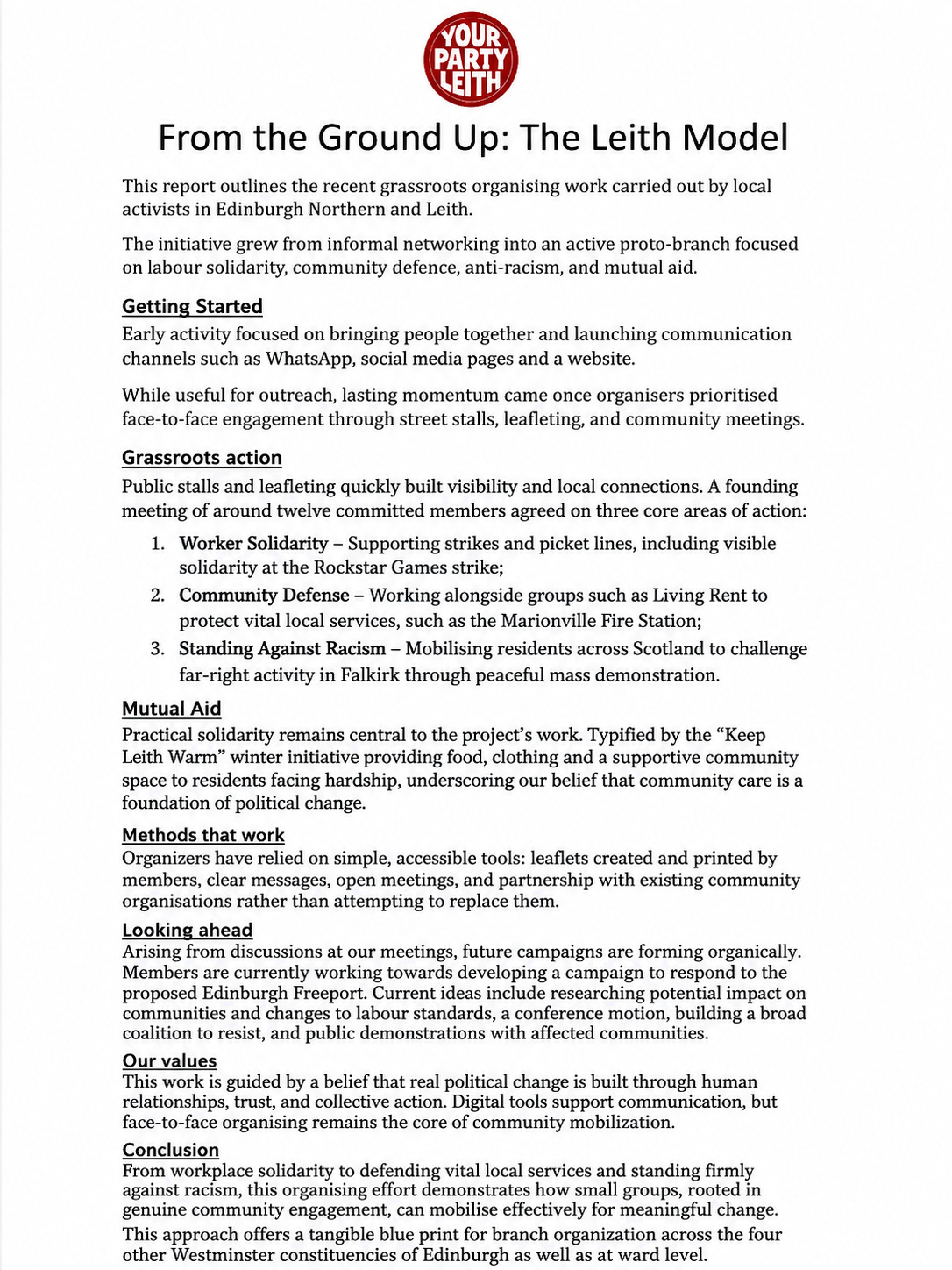
This is not a straightforward success story. In January this year, writing on ecosocialist.scot, I described what I called the Leith Model: worker solidarity through picket line presence, community defence through partnership with Living Rent, anti-fascist mobilisation, mutual aid. The account was, in places, more aspirational than accurate, and I added a postscript saying so. The Rockstar Games solidarity had been a single disorganised appearance, with organisers asking the banner to be put away. The Living Rent ‘partnership’ at Marionville had amounted to one stall after Living Rent had explicitly asked the branch to stay out. The gap between the manifesto and the method was real, and it needed to be named.
What happened next matters. The Leith comrades did not dissolve into recrimination or drift toward the Greens. They drew the lesson. The flag-planting instinct, the impulse to claim credit before trust has been built, had to be confronted directly. And the organising work that followed Your Party Scotland’s founding conference, which had itself been deliberately complicated by the Corbynite inner circle grouping known as The Many, seeking to prevent genuinely independent Scottish socialist organisation, produced something more durable precisely because it started from that honest reckoning.
Leith Organises has just been voted into existence. It is a community organising group explicitly broader than any single socialist organisation: open to people in no party, in the Greens, in the SNP, in Labour, with no requirement of prior political commitment. Its opening move is a listening campaign. Knocking on doors in Leith, not to recruit, not to hand out leaflets, but to ask people what their actual situation is. What are your key challenges? Not: what do you want to change? The first question elicits concrete grievances that can be acted on. The second produces abstract wish-lists that lead nowhere.
This is the answer to the comrade whose immigration precarity was met with promises of a future disciplined party. You start by listening. You show up. You ask what the problem actually is, in this street, for this person, this week. And then you do something about it, in coordination with the organisations already present rather than in competition with them.
Scotland is not a region. The method is transferable.
English activists should take Leith Organises seriously as a model, not as a Scottish curiosity. The national question means that whatever emerges from Sunday’s conference cannot treat Scotland as a region alongside Yorkshire and the South West. The YPS founding conference at Dundee had its own legitimacy, its own democratic character, and whatever organisation develops from it requires a fraternal relationship with the English federation, not administrative subordination to it. That is a political question the conference needs to resolve, not a structural detail to be settled in an appendix.
But the method is entirely transferable. Leith Organises in Burnley would look different. It would look different again in Norwich, in Swansea, in Coventry. The specific terrain varies. The approach does not: map who is already doing good work, partner with them rather than duplicating them, show up before asking anyone to show up for you, and start with listening.
What the test actually is
None of this should suggest that Sunday’s conference is not worth the time. It is. The federation form is correct; the structural proposals are serious; the people involved are serious. The question of how to govern democratically, how to prevent factional capture, how to maintain dual membership while building collective identity: these are real questions with real stakes.
But the test is not whether the structural proposals are well designed. It is whether, in eighteen months, there are groups in Burnley and Norwich and Swansea doing what Leith Organises is doing this week: knocking on doors, asking the actual question, building the relationships that no conference document can substitute for.
That question is, at present, genuinely open. Sunday’s conference does not resolve it. It only makes it possible to begin.
Postscript: The Socialist Federation Exists
Yesterday, May 31st, activists meeting online voted to found a Socialist Federation. The Members’ Charter process, which began as a salvage operation after Your Party’s leadership wrecked what should have been a historic opportunity, has produced something real: a name, a democratic mandate, a compositing process, and a June 28 conference to take it further.
The name change alone matters. Members’ Charter described a process. Socialist Federation describes a project.
Red Mole covered the conference proposals on Friday. The votes confirmed the federation direction decisively, passed a substantive interim platform, and endorsed the Socialist Education and Debate Association. The compositing process runs for the next fifteen days, after which the texts that will shape the June 28 conference will be published.
We will write in more depth then. What the compositing process does with the affiliation question, and whether the listening campaign model that is already working in Leith and Coventry gets built into the platform rather than remaining an aspiration, are the things worth watching.
For now: the Socialist Federation exists. That is not nothing. In a period when the left’s default mode is dissolution, it is worth marking.
The ecosocialist.scot piece on the Leith Model, including the January postscript, is available here. All twenty-seven conference submissions are available in the Members’ Charter document folder.
P.S. Below is a reformatted version of the Leith Model summary distributed on January 17, 2026.
Hi Duncan. This is an extremely useful article and although currently aimed at comrades in England could actually help us think about the new party project in Scotland in.particular the Federal framework as our next organisational.step. I also agree thst we would also benefit from input from comrades in Cymru'n Codi who seem to be on the same wavelength as republican socialists in Scotland
130 have signed up as of Friday morning.